November 9, 2005

Generation Rescue Thanks Autism Researchers

Update: This has been moved to Monday the 14th

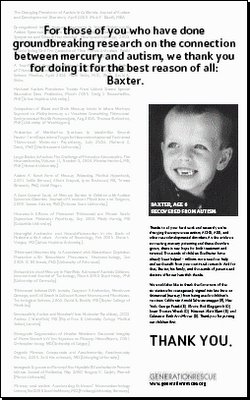
Generation Rescue is taking out a full page Ad in Friday's New York Times in the philanthropy section thanking the researchers that have added to our understanding of the mercury/autism connection so that our children could be treated.

I would like to add my thank you as well.


Click to see the full version and read text.

FBI Investigating Attack on Senate Staffer

This week Emilia DiSanto, top staffer for Senator Chuck Grassley (R-Iowa), was attacked in front of her home by a large, masked man wielding a baseball bat. The police are investigating it as an attempted murder. The FBI is looking into the possibility that the attack was work related and perpetrated by someone who did not like the Senator's "aggressive oversight of the public and private sector". The FDA and Big Pharma are among those in Grassley's cross hairs for not being vigilant enough with product safety.

I hate to think things have actually gotten that ugly, but thought it was something to keep an eye on.

Thanks to researcher Teresa Binstock putting these articles together.


FBI called in on Hill
By Bob Cusack and Jackie Kucinich
November 8, 2005

The FBI and Capitol Police are investigating the vicious attack of a top Senate staffer at her home last week amid concerns that the assault might be related to her work on the Finance Committee.

Emilia DiSanto, chief investigator for committee Chairman Chuck Grassley (R-Iowa), arrived at her suburban Virginia home after work Wednesday about 6:30 p.m. As she was unloading belongings from her car, a 6-foot-1-inch white man dressed in black struck her repeatedly with an unidentified object believed to be a baseball bat.

After she screamed to her family inside the house, the assailant fled. DiSanto was transported to Inova Fair Oaks Hospital, where she was treated for significant upper-body injuries. Nine staples were needed to close her head wound.

DiSanto, who declined to comment, has reported back to work.

The attack and the possibility that it was motivated by congressional business have made some people anxious on Capitol Hill.

"This is of obvious concern to anyone working here," a Senate staffer said. "It’s very disconcerting when you worry about someone resorting to violence. This could be intimidation, and you wonder whether it’s safe to do your job."

The attack on DiSanto came two days before a bomb threat caused alarm at an Iowa veterans home where Grassley was scheduled to appear.

According to the Iowa Times Republican, an anonymous caller told a switchboard operator Friday that a bomb would detonate in the center’s cemetery shortly before 1 p.m. The threat was not in the area where Grassley was scheduled to appear and later was deemed a false alarm. Grassley made the visit to the center as planned.

No evidence has surfaced that definitively points to DiSanto’s work on the Finance Committee as the trigger for the attack, but sources say there are a number of clues that suggest it could be.

The assailant was trying to hide his identity, wearing a hood and black gloves. He also did not make any demands before attacking the 49-year-old staffer. A working assumption among investigators is that he was waiting for her to arrive home.

Sources say acts of violence in DiSanto’s neighborhood are rare.

Grassley is known for his aggressive oversight of the public and private sector. Over the past year, he has scrutinized healthcare fraud, organ-donation procedures used by hospitals, drug-safety matters and the use of nonprofit groups related to former lobbyist Jack Abramoff.

In her line of work, DiSanto "doesn’t make a lot of friends," an aide said.

Grassley spokeswoman Jill Kozeny said federal and local law-enforcement officials have not ruled out the possibility that the attack was work-related. She said Grassley and DiSanto have discussed the incident.

The only reason why the FBI is involved is because the assault may have been work-related.

There is no indication that the bomb threat and the DiSanto event are related.

Fairfax County police are treating the attack as an attempted homicide.

Some Senate staffers said Capitol Police did not initially treat the attack as work-related late last week.

"We don’t do law enforcement, but that one was a really hard one to swallow," a Senate aide said.

Capitol Police said they were deferring to Fairfax County police, who are taking the lead on the probe.

In response to the attack, Ken Cunningham, Grassley’s chief of staff, sent an e-mail to Grassley employees urging them to report any suspicious activity or incidents to the Senate sergeant at arms. Cunningham noted in the e-mail that Grassley had asked the FBI to investigate.

Grassley is one of Capitol Hill’s most vocal critics of the FBI.

Capitol Police Chief Terrence Gainer said the unit is looking at the possible relationship between the attack on DiSanto and her position at the Capitol.

"I think all the agents involved are looking into the motive," he added.

Gainer said three agencies conferred Friday and yesterday to discuss the ongoing investigation.

An FBI spokeswoman confirmed the agency is looking into the attack.

Senate aides say they have been rattled by the incident, and some have taken extra precautions after hearing of it.

DiSanto has worked on the Hill for more than a decade. In July 2000, she was identified by Fortune magazine as one of the "Power 30" in Washington as the staff director for then-Senate Small Business Committee Chairman Kit Bond (R-Mo.). She also worked for the House Committee on Economic and Educational Opportunities in the mid 1990s.


Grassley Demands Answers on Safety of U.S. Experimental Drugs
by Kristen Hallam

Nov. 9 (Bloomberg) -- The head of the U.S. Senate committee that oversees the Medicare and Medicaid health insurance programs is demanding to know whether the government is doing enough to ensure safety during clinical trials of experimental drugs.

Citing what he called an "alarming" report by Bloomberg News, Senate Finance Committee Chairman Charles Grassley said federal agencies responsible for the drug trials owe the American people a better accounting of how the testing is conducted.

A report in the December issue of Bloomberg Markets magazine found conflicts of interest and lax oversight in the drug-testing industry. Over the past 14 years, the article said, private companies have largely taken over the job of conducting studies on experimental treatments, supplanting universities. Scores of people have died or been injured, the article said.

"Not only is this treatment of participating patients and their families alarming, but it also undermines the credibility of the pharmaceutical research and development process and places the value of new pharmaceutical products in question," Grassley, an Iowa Republican, wrote in a letter to the Health and Human Services Department's inspector general.

Grassley said Inspector General Daniel Levinson should quickly compile a list of recommendations his office has made since 1995 and determine whether the appropriate agencies are heeding them. The agencies include HHS, the Food and Drug Administration and the National Institutes of Health.

"We must take every possible step to ensure that our clinical trial system is in fact the 'gold standard' that we expect it to be," Grassley said. He asked for a briefing by Levinson's staff "at the earliest opportunity."

Tightening the Rules

Grassley said Levinson's office should examine the role of so-called institutional review boards that oversee the tests, with an eye toward adopting tougher oversight. The largest, Western Institutional Review Board of Olympia, Washington, is a for-profit company that oversees 17,000 trials.

Don White, a spokesman for Levinson, declined to say whether his boss has received the letter. "We are aware of Chairman Grassley's great interest in this area," White said. "We've obviously done work on this before and already have work plans for the future."

While Grassley's committee doesn't have direct jurisdiction over the FDA, he said its oversight of Medicare and Medicaid makes him responsible for ensuring medicines are safe. Grassley last year began an investigation of the FDA's handling of drug- safety issues after the withdrawal of Merck & Co.'s Vioxx painkiller.

Industry-Sponsored Tests

University medical faculties conducted 80 percent of industry-sponsored drug tests in 1991, according to the New England Journal of Medicine. Today, more than 75 percent of trials are done in doctors' offices or private test centers such as those run by SFBC International Inc., according to CenterWatch, a Boston-based compiler of clinical trial data.

In many cases, the people who volunteer for the drug trials are no longer protected by review boards at universities and now must rely on for-profit review boards. Drugmakers pay for both the private testers and the boards monitoring the trials, raising a potential conflict of interest, Grassley said.

Citing the Bloomberg article, Grassley wrote that test participants aren't always adequately warned of the risks.

"Some are dying as a result of the trials," Grassley said.

In Houston, the Fabre Research Clinic has been reviewed by an oversight company set up by Louis Fabre, the owner of the clinic. In Miami, SFBC International, which runs the largest private testing center in North America, has used a review company owned by the wife of an SFBC executive.

Shares of Miami-based SFBC dropped 26 percent after the Bloomberg report was published Nov. 2.

'Distortion of Our Work'

SFBC Chairman Lisa Krinsky said last week the report was a ``severe distortion of our work.'' She said the company complies with all regulatory standards and never has been issued a warning letter by the FDA.

A day after the Bloomberg report was published, Grassley said the FDA must do more to oversee clinical trials. In response to his comments, the FDA said last week in a statement that the agency ``is evolving our approach to clinical trial oversight. The protection of patients' rights is a fundamental focus.''

FDA spokeswoman Julie Zawisza yesterday declined to comment on Grassley's letter, saying she hasn't seen it.

"We do take very seriously our responsibility to protect people involved in clinical trials," she said.

The FDA also said it is examining its reporting rules and the other issues raised by the article.

Laboratory Rats

Because experiments on laboratory rats can't reliably predict how a chemical will affect people, human testing of new drugs is vital. Helped by extensive clinical trials, drugmakers have developed antibiotics capable of curing life-threatening infections and come up with revolutionary treatments for diseases like cancer and AIDS over the years.

"The vast majority of clinical trials conducted in the United States meet high ethical standards," the Pharmaceutical Research and Manufacturers of America, a Washington-based trade group, said last week in a written response to questions. "The U.S. regulatory system is the world's gold standard, and the Food and Drug Administration has the best product-safety record."

Ken Johnson, senior vice president for the trade group, said it would be inappropriate to provide detailed comments until the group reviews the practices in question.

"That review is now under way,'' he said. ``We are confident that our member companies are committed to conducting all clinical trials to the highest ethical standards."

The organization's members include Pfizer Inc., Merck & Co. and Johnson &
Johnson.

To contact the reporters on this story: Kristen Hallam in Washington khallam@bloomberg.net


Philadelphia Inquirer Examines Grassley Investigations of FDA, Pharmaceutical Industry
http://www.medicalnewstoday.com
July 6, 2005

The Philadelphia Inquirer on Sunday examined how Senate Finance Committee Chair Chuck Grassley (R-Iowa) "has increasingly turned his spotlight on [FDA] and the global pharmaceutical industry."

According to the Inquirer, Grassley has said that pharmaceutical companies and FDA moved too slowly to address safety problems of some drugs, including COX-2 inhibitors and antidepressants, in order to protect senior officials at the agency and possibly industry profits. His "investigators have swarmed over the FDA," and the finance committee "has become a favorite stop for agency whistleblowers," the Inquirer reports.

Grassley said, "If it looks like I am going after the pharmaceutical industry, it is probably because the FDA is not doing its job of faithfully executing the laws and carrying out their function of making sure that drugs are safe and effective." He added, "I guess it all comes down to making sure that Medicaid and Medicare dollars are spent on safe drugs."

Grassley ranks 30th in Congress in receiving campaign contributions from the pharmaceutical and biotechnology industries. He said those contributions are made to support his positions on low taxes and pro-business policy (Mondics, Philadelphia Inquirer, 7/3).


Sen. Grassley Calls for Investigation Into Reports That Drug Researchers Sold Early Drug Data to Wall Street Firms, USA
http://www.medicalnewstoday.com
August 10, 2005

Senate Finance Committee Chair Chuck Grassley (R-Iowa) on Monday sent a letter to US Attorney General Alberto Gonzales urging the Department of Justice to investigate whether doctors participating in clinical trials are selling confidential information to stock analysts and investors, the New York Times reports.

Grassley also sent the letter to Securities and Exchange Commission Chair Christopher Cox, whose agency already is examining possible insider trading involving the approval of prescription drugs...


Update: Apparently Liberty Post thinks that the oil companies are behind the hit, while Kos believes that this is the Republican party eating itself.

Bill to Ban Mercury Fillings

Bill to ban mercury dental fillings reintroduced in House

Nov. 3 -- U.S. Rep. Diane E. Watson, D-Calif., has reintroduced a bill that would ban the use of mercury in dental fillings.

The Mercury in Dental Fillings Disclosure and Prevention Act would prohibit interstate sales of mercury for use in dental fillings after 2008.

In addition, the bill would establish an immediate prohibition on the use of dental amalgams in pregnant women and children under 18.

"Mercury is the most toxic naturally occurring element on the Earth," Rep. Watson said. "Many Americans are still not aware that the vast majority of dental filling used by dentists - referred to as a silver filling - contains more than 50 percent mercury."

Watson contends that safer alternatives are available.

The American Dental Association has opposed Watson´s bill in the past, saying it would deprive patients of an essential treatment that is proven safe and effective.

Mercury can be toxic, but the process of making amalgam fillings binds the mercury and makes it stable and safe, according to the ADA. Banning its use would unnecessarily increase the cost of dental care, according to the AMA.

Reporter Seeks Parents of ASD Children on Medication

A reporter from the LA Times is doing a story on the tragic murders and suicide involving a teen from Aliso Viejo, CA who had Asperger's Syndrome.

Apparently, he was taking the medication Geodon (aka Ziprasidone)and the Times is investigating whether there is any link between side effects of his medication and the shootings. She would like to hear from any other parents whose children are taking this or medication like this and whether they feel the medication has dangerous side effects. Her name is Seema, and she can be contacted at: 714-966-5835 or at seema.mehta@latimes.com.

- Claire M. Bothwell

November 8, 2005

An Essay from a Non-Verbal Child on What It Is Like To Be Autistic

This was on one of my lists today. I really enjoyed reading it.

When my Dear Daughter's supervisor showed me this letter from one of her other clients, I immediately wanted to share it with all of you. I was amazed at how articulate this boy is and his depth of thought on the topic.

He is 9 years old, nonverbal, and diagnosed with severe autism. He just began using a Facilitated Communication device recently. The question my dd's supervisor posed was "What does autism mean to you." Here is his reply. I have typed his words verbatim. I have not altered his sentence structure or thoughts at all.

"What do I think autism means. To me it means not to be able to fully connect with myself. I can not control some of the things I say or do. I feel at times out of control. Other times I feel scared of what others may think. I have all my life had to prove to people that I am really intelligent and kind. Huge amount of people have finally believed in me. The toughest part of being autistic is the silly thoughts that go through your head. People don't understand what I am thinking of. It's frustrating. Autism is not easy to define to somebody who isn't but, the easiest way to put it into words would be probably disconnection from yourself and others. People are now understanding that it more prevalent. There needs to be more research on infants while in the tummy. I know there is some clues there. As to why there is autism. I'm just happy to be alive and healthy. I'm just lucky to have my family and friends. Having them helps me cope with life. I'm very lucky."

When my daughter's supervisor asked him if she could share this letter with others so that they could understand what it's like to have autism, he typed the following response:

"Yes. Yes please. I want others to know. I think it's important for people to know. I'm really proud of my paper. I worked really hard on it. Thank you."

I was blown away by the complexity of mind that this boy displayed. I taught typical 9-10 year olds in 4th grade for 5 years and this level of thought is rare indeed.

I hope you enjoyed it as much as I did.

Shelly and Natalie (3 and we have high hopes!)

The Age of Autism: Concerned in Tennessee

The Age of Autism: Concerned in Tennessee

By DAN OLMSTED
UPI Senior Editor

Susan Lynn would like some information, please: What is the autism rate among people living in the United States right now who have never been vaccinated? If you have that data or know where to find it, kindly contact her by the end of the month, care of the Tennessee House of Representatives, which is considering whether to ban a mercury preservative from childhood vaccines.

Lynn, a Republican member of the House, is sponsoring the bill. Lynn's colleagues in the state Senate already have passed it -- unanimously -- despite protests from the American Academy of Pediatrics and St. Jude Children's Research Hospital in Memphis. The pediatricians and the renowned hospital say the mercury preservative, called thimerosal, is not dangerous and not linked to autism or any other ailment.

What bothers Lynn is they can't tell her the autism rate in Americans who've never been vaccinated.

"It just occurred to us, why doesn't there seem to be a problem (with autism) among unvaccinated populations?" she said. "Of course, that's anecdotal. There hasn't really been a study done, but it doesn't seem that there is a problem among unvaccinated populations.

"It would certainly be wonderful if the federal government, or a group out there interested in this, would conduct a study, or maybe there already is information out there that can be gathered."

Lynn's question echoes one this column has been raising for several months -- where are the studies that would exonerate thimerosal by demonstrating that unvaccinated Americans have just as much autism as those who received the full slate of state-mandated, mercury-containing childhood immunizations?

"You have to ask yourself why are there no studies," Lynn said. "We have seen an explosion in autism. If we saw increases in any other disease like we've seen in autism, it would be a national crisis. Why is there no funding to investigate this?

"I think it would be very useful. I don't know if I'll be able to get that data by December when our study committee meets again. But gosh, if you could be any help. ... "

This column's admittedly anecdotal reporting has turned up what looks like a lower prevalence of autism among the mostly unvaccinated Amish in Pennsylvania, Ohio and Indiana. Federal health experts say that is not a good group to study because they might be protected from autism by their isolated gene pool.

They have not suggested an alternative.

There are other, less genetically similar groups that don't vaccinate based on their religious, philosophical or health views. An example: a significant subset of the 2 million children of families who homeschool. One doctor who treats such families says they have almost no autism, either.

A number of readers have offered similar observations about a number of other groups. But none of it is scientific or conclusive and, unless such studies are done, it never will be.

"We'd definitely want to look at a population within the United States of America because that's most relevant to us," Lynn said. "When you start looking at populations from other countries, you've got all kinds of other factors that we can't imagine."

Lynn said that absent such convincing information, she is willing to err on the side of caution and ban thimerosal from childhood vaccines.

"I read the science and read the experience of these parents and I realized, you know what, there really could be something here. And thimerosal is a poison. There is a skull and crossbones on that bottle. There's no reason to have that in there -- so let's take it out."

Lynn's interest in the issue stems from personal experience. Her son, Michael, was diagnosed with ADHD -- attention deficit hyperactivity disorder -- at age 3; their doctor said they would have to wait till he was 6 to put him on Ritalin.

"I said why wait? I'm going crazy," she recounted. Researching the subject on her own, she came across the controversial Feingold Diet that eliminates various foods including those with artificial colors, flavors or preservatives. "I put him on the diet 100 percent and in three days, to my own astonishment, I had a normal little boy.

"I was at my doctor when I showed him Michael could now sit still on the examining table instead of being under it and in all the drawers and everything. And I was totally dismissed. So we just agreed to disagree.

"Through the years I have given this information to a lot of parents and it's worked, it's helped them," Lynn said. "I realized there is a tremendous amount we don't know and there is a tremendous amount that doctors for whatever reason dismiss, even though parents will testify to them, 'This has helped my child.'"

Michael spent 10 years on the diet and now, at 21, is doing fine, Lynn said. When the controversy over a possible thimerosal-autism link arose, she learned that some scientists suspect ADHD and autism might be on opposite ends of a spectrum of neurodevelopmental disorders triggered by a toxic exposure. And she said she saw the same pattern of parents being ignored when they said their child had regressed after vaccination -- and in some cases improved dramatically after biomedical treatment.

In 1999 the U.S. Public Health Service and the pediatricians group urged that manufacturers phase out thimerosal in childhood vaccines as soon as possible. But they say scientific evidence now shows thimerosal is not responsible for autism; therefore, banning it ties their hands unnecessarily and injects politics in a medical decision based on "junk science."

Lynn says she can't understand that argument. "I think it would be the best public policy for the state of Tennessee to remove it from children's immunizations. Whether or not it does contribute to mercury toxicity or autism or whatever you want to call it, not giving tiny children and newborn babies a chemical that has a skull and crossbones on the bottle, injected directly into their bloodstream, can't be a bad thing."

Lynn also questions whether thimerosal is actually out of all routine childhood immunizations (it remains in most flu vaccines, which the Centers for Disease Control and Prevention now recommends for pregnant women and for infants 6 to 23 months old).

She said a Tennessee mother testified at a legislative hearing that her son received an immunization that contained thimerosal on May, 21, 2004. "He suffered immediate effects from that and was diagnosed with autism and he's being treated now and he is coming around," Lynn said.

Six states -- including California, New York and Illinois -- have banned thimerosal in childhood vaccines. Lynn said she is now canvassing them to determine whether the ban has caused problems.

--

This ongoing series on the roots and rise of autism welcomes reader comment. E-mail: dolmsted@upi.com

November 7, 2005

Press on the Burbacher Study?

Yay!

It was written last spring, but I am happy that it was picked up as it is such an important story that no one saw. I am not sure he got all the details right, but he definitely got the meat of the story. Hopefully more outlets will look into this for themselves.

Vaccine Additive Linked to Autism

By Douglas Fischer, STAFF WRITER

A mercury-laced preservative once widely added to pediatric vaccines exposes infants' brains to twice the neurotoxin previously suspected, offering evidence that health guidelines may underestimate the risk newborns face, researchers say in a report being published today.

The additive, thimerosal, has been used in vaccines since the 1930s and is almost 50 percent mercury by weight. Since 2001, manufacturers have gradually phased it out of almost all domestic pediatric vaccines, though it remains in use overseas in cheaper "multidose" vaccines.

The study, being published today in Environmental Health Perspectives, a peer-reviewed publication of the National Institutes of Health, also chides health officials for abandoning an earlier recommendation that the preservative be completely phased out and further studies conducted.

And it fuels the debate over the federal government's aggressive vaccination plan that subjects infants to a battery of shots some of which contain aluminum and other potentially harmful compounds in their first weeks of life.

"We're talking about a low-level delivery of a toxin given to a baby on the first day of its life," said mercury expert Boyd Haley, chairman of the chemistry department at the University of Kentucky, who was not involved in the study.

"What's needed is a total study of the sensibility of the vaccine program. Why would you want to vaccinate a baby on the first day of its life?"

The report is one of the first to look beyond mercury blood levels resulting from vaccines. Instead it examines both the amount and type of mercury reaching the brain. It suggests health officials examined the wrong compound and failed to look far enough when assessing the danger of mercury in thimerosal.

This is largely a past concern for the United States, given the predominance today of thimerosal-free vaccines. Both the study's lead author and the Centers for Disease Control and Prevention on Wednesday urged parents to have their children vaccinated.

"That's the first message," said Thomas Burbacher, lead author and associate professor in the Department of Environmental and Occupational Health Sciences at the University of Washington's School of Public Health.

"The bottom line is that trying to assess the effects of acompound with very little or no data is not a good thing to do. ... Unfortunately, we started doing studies on this compound way too late. Basic information like this should've been available decades ago."

The problem is very much alive for developing nations, however, where the additive is common. The World Health Organization has expressed interest in Burbacher's research.

The problem, Burbacher said, is that regulators trying to assess thimerosal's harm used as a benchmark methylmercury, a widely studied compound, rather than the little-known compound called ethylmercury in thimerosal. Both compounds cross the blood- brain barrier. But methylmercury breaks down slowly, whereas ethylmercury dissipates fairly rapidly, suggesting to regulators that a standard based on methylmercury would adequately protect infants.

Burbacher and colleagues found ethylmercury's fast breakdown leaves higher levels of so-called "inorganic" mercury in the brain. Inorganic mercury lingers in the brain for a year or more, potentially altering certain cells. A previous study has shown such damaged cells are also found in children with autism. Using monkeys, Burbacher found the brains of thimerosal-exposed infants had twice as much inorganic mercury as methylmercury- exposed infants.

The Food and Drug Administration has never required testing of thimerosal's safety or of its safe exposure levels for newborns and children. Although high mercury levels particularly as a result of vaccinations have long been suspected as a leading cause of skyrocketing autism levels, the CDC and Burbacher cautioned Wednesday against drawing any conclusion linking the two.

"To date, the vast majority of the science doesn't support an association between thimerosal and incidences of autism," said CDC spokesman Glen Nowak. But "at the end of the day, we still don't know what causes autism." Others, however, expect such links to become apparent as thimerosal fades from use in the United States. Already, noted Haley, California's autism rates have decreased three of the past four quarters a first. "There's something in the vaccines doing it. That something is thimerosal."

The FDA's Web site on thimerosal and vaccinations, including a chart showing common pediatric vaccines and the date thimerosal was eliminated, can be found at http:// www.fda.gov/cber/vaccine/thimerosal.htm. Contact Douglas Fischer at dfischer@angnewspapers.com.

Kelly from Walking With Alec

...ROCKS!

Burr's bill would make vaccines risky

In response to
"Burr steps into the spotlight" (Oct. 22):

Every parent should be concerned by Sen. Richard Burr's fast-tracked drug development bill.

If the vaccine industry is accountable to absolutely no one, how can we ensure that
profit won't stand in the way of safety?

We cannot allow the pharmaceutical industry's fear tactics to steal a basic right of our children: the right to go to court after being harmed.

Burr's bill is a slap in the face to families who believe their autistic children were damaged by thimerosal in vaccines.

The threat to children from vaccines produced without accountability far exceeds the threat from bioterrorism. If our government won't protect them, who will?

Kelly and Matt Langston

Another Chelation Success Story

http://www.wfsb.com/Global/story.asp?s=4069730

View the video by clicking the red camera icon next to "New hope for children with autism".

Children Who Have Recovered From Autism

As they do at the DAN conferences, on the first day they brought out several children who used to be autistic, and have recovered. It was quite inspirational. When ARI posts the video of the event I will be sure to let you know.

I had the honor of interviewing one of these kids. 16 year old Garrett. He gave a short speech at the conference. I will be posting that interview with the footage when it comes available.

Autism survivors speak in L.B.
By Kevin Butler, Staff writer

LONG BEACH — Hundreds of people attending an autism conference on Friday heard from parents who say that various treatments greatly reduced, or eliminated, their autistic children's symptoms.

The three-day "Defeat Autism Now!" conference, organized by a San Diego think tank, The Autism Research Institute, featured parents saying their autistic children dramatically improved, thanks to dietary regimens, behavioral therapy and various medications.

Not all researchers believe that all the touted remedies have been scientifically demonstrated.

About 10 children whose parents say have recovered from the condition were interviewed on-stage in front of a large audience at The Westin Long Beach.

Stan Kurtz said he and his wife were devastated when they learned their young son Ethan had autism.

"It's life-changing," he said. "You lose your child. Â… and you have to rebuild. You have to see what's really going on."

Ethan, now 4 years old, didn't speak and often just stared out the window, Kurtz said.

Now his son's symptoms have largely gone away, thanks to a combination of drugs and dietary changes, said Kurtz, a Tarzana resident.

Kurtz on Friday asked his son to describe his favorite book, "Charlotte's Web."

Speaking of the main character, a

Advertisement
Click Here!

pig called Wilbur, Ethan Kurtz smiled and said, "He was a baby, and then he grew up."

Cindy Goldenberg said until her son started a drug treatment when he was 3 years old, he wouldn't speak, make eye contact or play appropriately.

At around age 3, her son Garrett now 16 years old started receiving infusions of a protein used to treat immune deficiencies, she said. She said his symptoms were gone by the time he was 5 years old.

"I feel like I not only got a miracle, but I got a second chance," said Goldenberg, a Laguna Niguel resident.

Goldenberg, like some other parents at the conference, subscribes to the controversial theory that her child's condition was linked to a vaccine used to ward off measles, mumps and rubella.

The U.S. Centers for Disease Control and Prevention, however, has stated that "the weight of the evidence indicates that vaccines are not associated with autism."

November 2, 2005

An Update from David Kirby

Last Sunday at the Long Beach DAN! Conference, David Kirby spoke, updating the group on the latest on his book, Evidence Of Harm, and where the vaccine/autism story has come to date. Afterward was good enough to sit down with me and answer a few questions.

-----------------

Mr. Kirby announced that the paperback version of the book will be coming out in March, and will contain updates to the story since the book was published. St. Martin’s press has selected the book as one in a four-title collection for a book club series.

-----------------

The movie rights to Evidence Of Harm have been sold to Participant Productions with Nick Wechsler producing the project. The film is currently in development with plans to begin filming next year. Participant is a self-described socially conscious production company committed to bringing films to the screen that “Change the world one story at a time”. Among their current projects are North Country, with Charlize Theron, and the Good Night, and Good Luck, the story of Edward R. Murrow’s battle with Senator Joseph McCarthy, with George Clooney,

-----------------

Last week Mr. Kirby was invited by professors at NYU Law School to discuss the topic of thimerosal in vaccines at a project they are undertaking on medicine and human rights. Professor Mary Holland and her colleagues are viewing the thimerosal story in terms of potential human rights violations, with an eye toward presenting their findings to the United Nations.

-----------------

During his speech he touched on the current Bio defense bill, which will create a federal health department that would not be subject to the Freedom of Information Act, but would create public health policy. This department would have the power to order mandatory vaccinations of the general public, but its decision making process would not be open to public scrutiny.

Mr. Kirby points out that if FOIA revocation had been in place 5 years ago, we would know little about government action in regards to thimerosal and Evidence of Harm would not have been written.

-----------------

He also announced that Senator Joseph Leiberman would be introducing legislation to force the Center for Disease Control to open the Vaccine Safety Datalink to researchers, as the autism community as been asking. The CDC has restricted access to the VSD since Mark and David Geier discovered a link between thimerosal containing vaccines and autism using the VSD in 2004 in violation of federal law. Indeed the Lieberman legislation was introduced on Monday.

Mr. Kirby also told the crowd in attendance that has learned that the day that the Geiers last accessed the VSD, an order had been given by the CDC that as soon as they left the building, the data was to be removed from computer system. This order was carried out, and the following day the database was transported to the headquarters of the CDC and subsequently placed with a private company where it could not be accessed by FOIA.

-----------------

In addition he discussed the findings of the Burbacher study done by the National Institute of Health and published this spring. Burbacher's primate study expanded the understanding of how thimerosal behaves in the body in comparison to the way methyl mercury behaves in the body.

EPA safety limits for mercury are based on observations of the toxicity of ingested methyl mercury. It had previously been thought that because the ethyl mercury in thimerosal clears the blood stream in about the third of the time that methyl mercury does, and because ethyl mercury was a larger molecule, which made it more difficult for it to cross through the blood brain barrier, that ethyl mercury (the type in thimerosal) was the safer form of the two.

Burbacher's study confirmed that thimerosal did indeed clear the blood stream more quickly, and had more difficulty entering the brain, however it was discovered that once ethyl mercury was in the brain it oxidized and converted into inorganic mercury at a much higher rate than methyl mercury. From previous studies from Burbacher and NIH, we know that while organic mercury in the brain has a half-life of around 30 days, inorganic mercury in the brain has a half-life estimated at 20 years.

This of course would mean that the EPA, and all other government safety standards for methyl mercury would be woefully lacking in regard to thimerosal.

When the study was published in Environmental Health Perspectives, an NIH journal, the CDC issued a press release that stated that it showed that thimerosal cleared the blood faster than, and entered the brain less readily than methyl mercury, but made no mention of the fact that when the primates were sacrificed, the subjects given thimerosal had 4 times the inorganic mercury in the brain than the subjects who ingested methyl mercury.

The press picked up on the press release, printing that the mercury in vaccines was safer than the mercury in fish, when in fact the study had found that the opposite was true.

Burbacher was upset by this and demanded that the CDC issue another press release correcting the record. The CDC did so, but when the new press release was issued, it still made no mention of the finding that thimerosal was 4 times as toxic to the brain as mercury in fish.

Mr. Kirby has discovered that the CDC had hired a Triangle Park PR firm to issue the public statements and that the firm also represented several vaccine manufacturers.

-----------------

A few of Kirby’s detractors have written that he had previously been associated with Act Up, the AIDS activist group considered by many to be extreme in their tactics. I asked Mr. Kirby about his association with the controversial group, and he said that he had never been affiliated with Act Up.

Mr. Kirby told me that he had worked on David Dinkins campaign in his run for mayor in 1986 and during that time part of his responsibilities were to act as liaison to the AIDS support and awareness groups in the city. Act Up was one of those groups.

From 1990 to 1994, he worked for The American Foundation for Aids Research (AMFAR), a main stream AIDS research fund-raising organization for which Elizabeth Taylor acts as a spokesperson, where he again acted as liaison to other AIDS groups Act Up included.

During his tenure in both of these positions, he reports that he attended a few Act Up meetings as a representative of Dinkins campaign or AMFAR, but that he never did any work for them nor attended any of their demonstrations. He actually said that a few of their members had criticized him for being too mainstream in position.

Mr. Kirby reports that he did write one AIDS related article about a group of AIDS protesters that were arrested and not allowed access to their medications while in custody.

He had not heard of the accusation of his involvement with Act Up, and assumes that whoever started the rumor had confused Act Up with AMFAR.

Safe Minds on Flu Vaccines

SafeMinds Issues Urgent Warning on Risk to Pregnant Women, Children,Infants of Exposure to Mercury from Flu Shots; As Bird Flu Plan is Unveiled

WASHINGTON, Nov. 2 /U.S. Newswire/ -- As the flu season approaches and the Bush administration begins sharing details of their plan to prevent a possible avian flu pandemic, much emphasis is being placed on the idea that flu shots should be readily available and administered to large portions of the population. But lost in these numerous media reports is the danger posed by mercury found in a majority of annually administered flu vaccine preparations.

"Consumers are not aware of the fact that flu shots still contain thimerosal, a mercury based preservative recently phased out of most childhood vaccines," said Lyn Redwood, president of SafeMinds, a non- profit organization dedicated to raising awareness and conducting research into mercury exposure. Most alarming to Redwood is the fact that pregnant mothers and infants are now targeted to receive the annual flu vaccine when they are exactly the populations known to be most vulnerable to exposure to mercury. "We know from study after study that mercury rapidly crosses the placenta, enters the fetal brain and interrupts critical stages of development," said Redwood.

The
CDC's recently recommended exposure to mercury from flu vaccine comes despite the fact that one in every six women of childbearing already has blood levels of mercury high enough to harm their unborn children from environmental exposures. An EPA announcement came on the heels of a report, which found that the fetus actually accumulates mercury and typically has blood levels 70 percent higher than those found in the mother at the time of birth.

According to Mark Blaxill, director of SafeMinds, "Why on earth would the CDC on one hand recommend that pregnant mothers avoid environmental exposure to mercury from eating seafood, but on the other hand ignore the danger from mercury administered in vaccines when they know that an average flu vaccine exceeds EPA's safe level of daily mercury exposure in the average woman by four fold? By suggesting that a direct injection of ethyl mercury via a flu shot is harmless, and indeed by recommending that exposure, these policies defy not only sound medical practice but common sense."

"If you choose to be immunized against regular flu, you should know what benefits you're actually getting," continued Blaxill. "American consumers should make informed decisions about their health. Amidst rising fears over a theoretical avian flu pandemic, numerous health officials have tied the avian flu risk to the regular annual flu shot, but most people don't realize that the annual flu shot won't protect you against avian flu. In addition, pregnant women also should know that recent scientific studies show little support or benefit to them or to their fetus from a flu shot."

SafeMinds also expressed concern about the blanket protection from liability for vaccine manufacturers offered in Bush's flu pandemic plan.

"Any kind of blanket immunity will only take away incentives for producing safe products and inevitably, will set our country up for a bad outcome," continued Redwood. "Immunity from legal liability for injury will result in vaccines that are less safe, which in turn will cause declining public confidence in vaccines."

The claim that the threat of lawsuits has kept manufacturers from entering and staying in the vaccine business has long been touted as a reason for protecting the pharmeceutical industry. Language providing relief from liability for vaccine manufacturers has been introduced unsuccessfully over the past several years. Although supporters of these bills claimed that intervention is needed to address concerns over the vaccine supply, the past problems that occurred were a result of long overdue FDA enforcement actions concerning violations of good manufacturing practices and complacency on the part of the manufacturers for production and distribution of their products, not litigation.

As the avian flu scare becomes increasingly political, SafeMinds is urging consumers to take a critical view of the rising media hype. SafeMinds encourages doctors to educate themselves and their patients about the risks of mercury exposure before administering the flu vaccine and to recommend only mercury free vaccine products for their patients.

More information about SafeMinds (including neurodevelopmental disorders, autism and mercury exposure) may be found at http://www.safeminds.org or by calling Stephanie Morris at 202-628-7772.

November 1, 2005

The Age of Autism: The Amish Elephant

The Age of Autism: The Amish Elephant

By Dan Olmsted
UPI Senior Editor
Oct. 29, 2005 at 2:34PM

A specter is haunting the medical and journalism establishments of the United States: Where are the unvaccinated people with autism?

That is just about the only way to explain what now appears to be a collective resistance to considering that question. And like all unanswered questions, this raises another one: Why?

What is the problem with quickly and firmly establishing that the autism rate is about the same everywhere and for everybody in the United States, vaccinated or unvaccinated? Wouldn't that stop all the scientifically illiterate chatter by parents who believe vaccinations made their children autistic? Wouldn't it put to rest concerns that -- despite the removal of a mercury-containing preservative in most U.S. vaccines -- hundreds of millions of children in the developing world are possibly at risk if that preservative is in fact linked to autism?

Calling this issue The Amish Elephant reflects reporting earlier this year in Age of Autism that the largely unvaccinated Amish may have a relatively low rate of autism. That apparent dissimilarity is, in effect, a proverbial elephant in the living room -- studiously ignored by people who don't want to deal with it and don't believe they will have to.

Here are a few cases in point.

Earlier this month the National Consumers League conference in Washington held a session on communicating issues around vaccine safety. I was on the panel and talked about the Amish and autism. In the Q&A session that followed, the first question was for me.

"Is this a proper role for a journalist, or is this just a straw dog set up there with a preliminary answer? It not only showed up where you wrote it. It was all over the place. You did very, very well for UPI (at which point I said, 'Thank you -- please tell my bosses that!') but the question is, did you do very, very well for America?

"Is it appropriate for a journalist -- you weren't reporting, you were investigating. And I just wonder if you think it's an appropriate role for you to play."

My answer: "There's different roles for the press. That's certainly a reasonable question. That is investigative reporting. This idea is something that's already been discarded -- that there's any reason why you would want to look in an unvaccinated population.

"One of my favorite comments about journalism is that it's the wild card of American democracy. The First Amendment says we can do (in the sense of reporting about) whatever we want. So one of our privileges is to get an idea in our head and go look at it."

My questioner was not finished. "I wasn't questioning whether you have a First Amendment right to do it. I think this is more of a question of the ethics, of what value we are bringing to the debate."

My response: "That's probably not a good one for me to answer. Obviously I thought it was ethical."

At that point a fellow panelist, Dr. Louis Cooper, former president of the American Academy of Pediatrics and a staunch vaccine defender, spoke up. "I would jump in and say I thought it was ethical and I think it was useful," said Cooper, a courtly and unfailingly courteous Manhattan pediatrician.

"As you've learned, it was annoying to many people. I wasn't annoyed by it because I thought you kept the process and the debate and the discussion going forward. And we have to do that for one another."

That did not end the discussion. A few minutes later a public-health professor from -- where else? Harvard -- did her own version of Jeopardy!, offering the correct "answer" in the form of a question.

"This question is for Dan. Did you mention the outbreak of polio that happened in the Amish community in the Netherlands that caused widespread problems there, and also the fact that there'd been some context with respect to history in our country in trying to reach out to the Amish to actually encourage them to try to benefit from some of the vaccine technology to the extent that we could?

"So there's been a long history in this country of the CDC trying to reach out to them to the extent that they could. Also with respect to polio, I think what's really amazing is it's such a great story, this is such an exciting time, in the sense that we are very close to global eradication. What that means is we've gone from 1988 when we had 350,000 estimated paralytic polio cases in the world every year to roughly a thousand. It's very exciting that in fact we don't have the terror or the hysteria and all of the fear that surrounded disease.

"I just want to remind everyone that one thing that's very important in the context of reporting these stories is making sure that people do remember and also realize with infectious disease is these things can come back, and until they are eradicated they can come back and devastate us just as much as they did before, except now there are a lot more people.

"There's some related news that people might find interesting. A headline in the Washington Post today, 'Polio outbreak occurs among Amish families.' So I thought people might be interested in that."

At that point the moderator, Dr. Roger Bernier of the Centers for Disease Control, said time was getting short -- why was I not surprised? -- and asked for the next "question."

One thing I've noticed is the more that people want to lecture instead of learn, the more they speak in breathless run-on sentences that are hard to stop, slow down or even diagram. They leave one with the unspoken idea that dialogue -- opening the door to new information -- is somehow dangerous.

These exchanges reminded me of the response I got from Dr. Julie Gerberding, the CDC director, when I asked her this summer, verbatim: "Has the government ever looked at the autism rate in an unvaccinated U.S. population, and if not, why not?"

Her answer, verbatim:
--

In this country, we have very high levels of vaccination as you probably know, and I think this year we have record immunization levels among all of our children, so to (select an unvaccinated group) that on a population basis would be representative to look at incidence in that population compared to the other population would be something that could be done.

But as we're learning, just trying to look at autism in a community the size of Atlanta, it's very, very difficult to get an effective numerator and denominator to get a reliable diagnosis.

I think those kind of studies could be done and should be done. You'd have to adjust for the strong genetic component that also distinguishes, for example, people in Amish communities who may elect not to be immunized (and) also have genetic connectivity that would make them different from populations that are in other sectors of the United States. So drawing some conclusions from them would be very difficult.

I think with reference to the timing of all of this, good science does take time, and it's part of one of the messages I feel like I've learned from the feedback that we've gotten from parents groups this summer (in) struggling with developing a more robust and a faster research agenda, is let's speed this up. Let's look for the early studies that could give us at least some hypotheses to test and evaluate and get information flowing through the research pipeline as quickly as we can.

So we are committed to doing that, and as I mentioned, in terms of just measuring the frequency of autism in the population some pretty big steps have been taken. We're careful not to jump ahead of our data, but we think we will be able to provide more accurate information in the next year or so than we've been able to do up to this point. And I know that is our responsibility.

We've also benefited from some increased investments in these areas that have allowed us to do this, and so we thank Congress and we thank the administration for supporting those investments, not just at CDC but also at NIH and FDA.

--

The latest response to my pesky persistence comes not from academia or government but from my own profession. Last week the prestigious Columbia Journalism Review published an article whose main thrust -- with which I concur -- was that a vigorous debate over a possible link between vaccines and autism was being thwarted by the self-induced timidity of the press.

Some reporters told the author, Daniel Schulman, that they have basically given up on the story because the criticism -- some of it from their own editors -- was so fierce, and the story was so complicated.

Schulman described Age of Autism's efforts to come at the issue "sideways," looking for possible clues to the cause of the disorder in the natural history of autism. And he mentioned our reporting on the Amish:

"Privately, two reporters told me that, while intriguing, Olmsted's reporting on the Amish is misguided, since it may simply reflect genetic differences among an isolated gene pool. ... Both reporters believed that Olmsted has made up his mind on the question and is reporting the facts that support his conclusions."

Ouch. Being slammed by one's peers is never enjoyable, although reporters need to have thick skins and realize they dish this kind of thing out every day. (And those anonymous sources really are annoying, especially when I am happy to be quoted by name about everything.)

What's interesting about the reporters' "private" remarks is the degree of presumed expertise they suggest -- that looking at the Amish is misguided "since it may simply reflect genetic differences among an isolated gene pool." Really? Where did these guys get their doctorate in genetics, Harvard?

This assertion -- that the Amish gene pool could explain everything, based on no data that I'm aware of -- is the kind of self-interested speculation masquerading as expertise that has beset the autism-vaccines discussion for far too long. The term I learned for it long ago is "convenient reasoning," and it does not always have to be conscious.

The Amish have all kinds of standard genetic mental and developmental disorders -- from bipolar to retardation -- and a lot more genetic issues to boot from this supposedly protective "isolated gene pool." The doctors who actually know something about the Amish have never suggested to me that genes have anything to do with a low rate of autism. They seem perplexed.

In upcoming columns, we'll put that question to the right people -- geneticists -- and tell you what we find. It's called reporting.