Showing posts with label Glaxo. Show all posts

February 26, 2011

GlaxoSmithKline Vaccine Sales Employees on How Unethical GSK Is

Occasionally I pop over to CafePharma.com, online hang out for pharma worker bees, and look at the vaccine discussion there. I thought I would share this one with you. Someone pops in and asks what it is like to work for GSK in vaccine sales.

Note this description of the ethical atmosphere at GlaxoSmithKline (maker of the UK MMR vaccine and chief tormentor of Andrew Wakefield):

Actually, if you are a sadist who enjoys inflicting misery on others and you can get a management job GSK is a pretty good gig.

If you want to be tagged as management material, be sure to emphasize any illegal and / or unethical conduct at previous companies. That is a HUGE plus at GSK these days. Also, any examples of behaviour dehumanizing others is important - rapes, war crimes, etc.

Good luck.


  #1  
Old 12-05-2010, 09:34 PM
Anonymous
Posts: n/a
Default Vaccine Sales

Currently interviewing with your company for an Immunization Sales Specialist position; looking for CONSTRUCTIVE feedback on pros/cons of this position. Is there more career stability in this division vs. pharma?
Reply With Quote
  #2  
Old 12-05-2010, 10:19 PM
Anonymous
Posts: n/a
Default Re: Vaccine Sales

The best thing you can do right now is run like hell and never speak with GSK again. GSK is a hell hole sweatshop. The only reason people are still employed by GSK is to qualify for retirement / severance / VRIF. There is no other reason to be at GSK right now.
Reply With Quote
  #3  
Old 12-05-2010, 10:40 PM
Anonymous
Posts: n/a
Default Re: Vaccine Sales

Disagree with the above post. I am in the Vaccine Business Unit. We have had some difficult times as has almost every division and almost every company. All things considered its not a bad place to be.
Reply With Quote
  #4  
Old 12-05-2010, 10:43 PM
Anonymous
Posts: n/a
Default Re: Vaccine Sales

Thanks for your reply I've kind of gathered this from all of the other threads I've read. I've heard about rumors of GSK acquiring Novartis vaccine division in the very near future...any chance this new entity would be worth entertaining?
Reply With Quote
  #5  
Old 12-05-2010, 11:40 PM
Anonymous
Posts: n/a
Default Re: Vaccine Sales

If you have a thick skin and do not need to be praised for the work you do.
If you have a strong stomach for humiliation
If you can work hard everyday and still be thought incompetent by your boss.
If you can lived day to day wondering if you will have a job next month
If you dont mind feeling like an ax is ready to fall on your neck
If it is ok with you to sell products that might be dangerous
If riding with a micro-manager every 2-3 weeks is your idea of support
If you can stand to be considered a cog in a wheel and not a person

Then by all means---------------go to work for GSK
Reply With Quote
  #6  
Old 12-06-2010, 09:11 AM
Anonymous
Posts: n/a
Default Re: Vaccine Sales

Actually, if you are a sadist who enjoys inflicting misery on others and you can get a management job GSK is a pretty good gig.

If you want to be tagged as management material, be sure to emphasize any illegal and / or unethical conduct at previous companies. That is a HUGE plus at GSK these days. Also, any examples of behaviour dehumanizing others is important - rapes, war crimes, etc.

Good luck.
Reply With Quote
  #7  
Old 12-07-2010, 12:48 PM
Anonymous
Posts: n/a
Default Re: Vaccine Sales

Unfortunately, this position isn't what it used to be.

Consider the state you're in, and how VFC Vaccines are supplied. If there's open access and choice for your accounts, you might have a good position.

Also consider how many groups there are, as this division just moved to account managers in many areas that are covering large purchasing groups. If your position has a lot of large private business, it might be fun. All the small accounts are getting passed to telesales, so watch out.

The biggest problem right now in this division is supply, and how it impacts the selling contracts. They aren't making allowances to customers for the shortages, and it's a problem.

They've "pharma-ized" this division as of Jan 2009, so it's a lot about metrics and less about sales.

Oh, and by the way, speaking of sales: you won't get paid on your sales...no one at GSK gets paid on territory sales anymore. Good luck.
Reply With Quote
  #8  
Old 12-07-2010, 11:47 PM
Anonymous
Posts: n/a
Default Re: Vaccine Sales

I am in the vaccines business unit. It is a little more stable than pharma however, we have had our share of challenges. Just went through a really big cut in sales force so hopefully no big ones comming up again soon. Most reps are full line now which means you have quite a few products to learn both pediatric and adult.

Your life could be hell though if you are in a territory where you have lot's of big systems and your vaccines are not available on that groups formulary per say than you have no control also important to see if you have a lot of VFC.

Just do your homework and find out why the position is open and what the challenges are in that market before signing on the dotted line
Reply With Quote
  #9  
Old 12-08-2010, 01:28 AM
Anonymous
Posts: n/a
Default Re: Vaccine Sales

those jobs are crap.
you are done and wont make 70 grand
history
from, a former vaccine mgr at gsk............dont fall for it.............fool
Reply With Quote
  #10  
Old 12-12-2010, 10:29 PM
Anonymous
Posts: n/a
Default Re: Vaccine Sales

Lots of work, pressure and bullshit for little or no bonus. Negotiate the highest salary possible. Don't buy the bonus potential, it's a joke. Also be prepared to work lots of hours with little success. Your manager will feel a lot of pressure from above and it will all fall on the reps.

February 12, 2010

Anatomy of a Witch Hunt

Much has happened in the last few weeks surrounding Andrew Wakefield, and I have not been available to write about it. It has been truly frustrating to see this story reported as if the GMC hearing was legit and The Lancet as if it was a respectable and unbiased publication, rather than the dog fight between corporate interests and safety advocates that it actually is. Was the fact that 21 autism organizations in the US and UK filed perjury charges against the head of the Lancet for lying about Wakefield's disclosures of his conflicts in the GMC hearing not relevant to the fact that the Lancet retracted Wakefield's article the following week? Apparently the press didn't think so.

Also fascinating that they have tried to portray Wakefield as the guy that invented the autism/vaccine connection, despite the fact that Leo Kanner reported that one of his first 11 cases in the 1940's was a regression following a smallpox vaccine, the VCIP has been paying autism cases for 25 years, and I first heard about the connection in my undergrad psych program in 1988 at George Mason University, so that they can use this GMC hearing to declare the vaccine controversy over. (I have forty or so studies on my "no evidence of any link" page supporting the vaccine/autism connection and I have never even had Wakefield's MMR paper up there.

Fortunately AOA has been all over this.

Today I had an hour and started mapping out the conflicts on interests in all of the forces that are posing as unbiased sources and trashing Wakefield and his work by charging him with conflicts of interest. The irony is lost on too many people.

It is a work in progress. One of my friends in the UK is looking it over to help fill in more of the blanks, so it will be updated.

A few notes not on the chart. Judge Nigel Davis is the judge who ruled that families trying to sue GlaxoSmithKline for the damage done to their children by the MMR would not be given legal aid to do so, ending MMR litigation in the UK. His brother is Sir Crispin Davis, who was the CEO of Elsevier, publisher of The Lancet and was also on the board of GlaxoSmithKline. Additionally... Paul Offit is an industry spokes person for Merck, that was too long to fit into the chart, so I used the more pejorative, "lap dog". And there is word out this afternoon that another Elsevier journal may be trying to bury the Hep B monkey study that Wakefield worked on, although no word from the journal on this yet.

Look at the energy flow in this thing... Props to Dr. Wakefield and his compadres for not backing down under this insane amount of industrial pressure. I mean just look at this billion dollar medical/pharma/media/(arms sales?) unprincipled conglomco machine! Eliot Ness wasn't even up against this big of a beast when he took on the mob. And I have not even included any of the public health infrastructure, or the GMC in this flow chart.

Keep your head up England, and understand that you are under a blitz. They are now officially throwing everything they have at you and they are only exposing their own corruption. Never, never, never, never give up.

Problem for the beast is... they are using all their ammo, and six months from now, nothing will have changed for them. Because the public knows they are full of crap.

click to see it full size.


UPDATE:

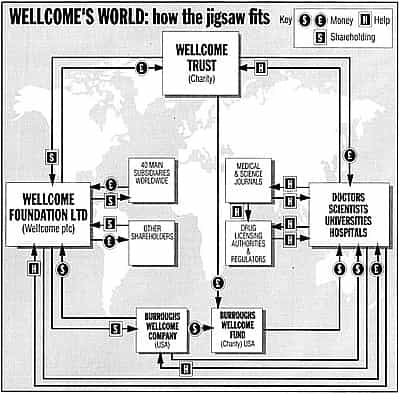
A friend in the UK brought something interesting to my attention. It is a flow chart done by a journalist in 1994 on how money and influence flowed around the Burroughs Wellcome pharmaceutical company and all it's satellites (foundations, trusts, doctors, medical institutions, universities, medical journals and even regulatory agencies). One of which is the Wellcome Trust.

I invite to you take a look at the amazingly, unbiased and completely free of conflicts of interesty type research that Wellcome is funding, by reading my piece on Professor Alan Emond's study that shows that kids with autism don't have bowel problems. He claims no conflicts of interest, but fails to mention that he is on the UK's Joint Committee on Vaccination and Immunisation (Britian's version of the CDC's Advisory Committee on Immunization Practices.)

The chart certainly enhances the understanding of how the machine works, but the two facts that make this flow chart so much more interesting is that Burroughs Wellcome of course became Glaxo Wellcome, which became GlaxoSmithKline, who makes the MMR; and that the journalist that created this chart was Brian Deer.


UPDATE: One commenter was looking for a source for my 20 billion dollar figure.

Drugmakers, Doctors Rake in Billions Battling H1N1 Flu
Swine Flu Is Bad for Victims, But Good for Businesses That Cater to Expanding Market
By DALIA FAHMY
Oct. 14, 2009
ABC News/Money

Americans are still debating whether to roll up their sleeves for a swine flu shot, but companies have already figured it out: vaccines are good for business.
h1n1.

Drug companies have sold $1.5 billion worth of swine flu shots, in addition to the $1 billion for seasonal flu they booked earlier this year. These inoculations are part of a much wider and rapidly growing $20 billion global vaccine market.

"The vaccine market is booming," says Bruce Carlson, spokesperson at market research firm Kalorama, which publishes an annual survey of the vaccine industry. "It's an enormous growth area for pharmaceuticals at a time when other areas are not doing so well," he says, noting that the pipeline for more traditional blockbuster drugs such as Lipitor and Nexium has thinned.

As always with pandemic flus, taxpayers are footing the $1.5 billion check for the 250 million swine flu vaccines that the government has ordered so far and will be distributing free to doctors, pharmacies and schools. In addition, Congress has set aside more than $10 billion this year to research flu viruses, monitor H1N1's progress and educate the public about prevention.

Drugmakers pocket most of the revenues from flu sales, with Sanofi-Pasteur, Glaxo Smith Kline and Novartis cornering most of the market.

But some say it's not just drugmakers who stand to benefit. Doctors collect copayments for special office visits to inject shots, and there have been assertions that these doctors actually profit handsomely from these vaccinations.

It is a notion that Dr. Lori Heim, president of the American Academy of Family Practitioners, says is simply not true.

"According to most of the physicians I have talked to, the administration of these vaccines is done for the community's benefit as opposed to anything that helps profit," she says. Heim adds that even though doctors will not have to shell out for the H1N1 vaccine, they will bear the usual costs associated with storage and administering the shots.

"There is an administration fee, for the costs that you can't get reimbursed through Medicare or Medicaid," she says. "This is usually less than, or right at the break-even point."

Still, pharmacies also charge co-payments or full price of about $25 to those without insurance and often make more money if patients end up shopping for other goods.

"Flu shots present a good opportunity to bring new customers into our stores," says Cassie Richardson, spokesperson for SUPERVALU, one of the country's largest supermarket chains. Drawing customers to the back of a store, where pharmacies are often located, offers retailers a chance to pitch products that might otherwise go unnoticed.

Even companies outside of the medical industry are benefiting: the UPS division that delivers vaccines in specially designed containers, for example, has seen a bump in business.

New Entrants in Flu Shot Business

The intensifying competition has irked some doctors.

"Retailers and other non-medical professionals have siphoned off the passive income that once helped to cover medical overhead," says Dr. Caroline Abruzese, an internist in Atlanta. "The larger retail chains can invest up front in large volumes of vaccine at low prices, and market to customers already in their stores."

The promise of profits has attracted new players into the business. Some of the world's largest drugmakers, who in the past avoided the vaccine market because of its limited scope -- its not easy to convince healthy adults to get a shot for measles -- are now jumping into the fray.

Last month alone saw three large vaccine deals. Abbott Labs bought a Belgian drug business, along with its flu vaccine facilities, for $6.6 billion. Johnson & Johnson invested $444 million in a Dutch biotech firm that makes and develops flu vaccines. Merck, which already makes vaccines for shingles and other diseases, struck a deal to distribute flu shots made by Australian CSL.

Smaller biotechs are also angling for a slice of the action, making vaccines one of the fastest-growing areas of research in the biotech industry.

Large and small drugmakers are drawn to the business largely because of scientific advances that promise to radically expand the range of health problems that vaccines can address. In addition to preventing childhood diseases such as measles and polio, vaccines can now also ward off cervical cancer, and researchers are working on vaccines for HIV and tuberculosis.

Scientists believe they can create therapeutic vaccines than treat diseases such as Alzheimers and diabetes after they have set in. (At least one company is betting on a vaccine that helps cigarette smokers quit.)

"These innovations broaden the market potential for vaccine makers and partly explained the renewed interest by drugmakers," says Anthony Cox, a professor at Indiana University's Kelley School of Business who specializes in the marketing of medical products.

But Mark Grayson, a spokesperson for the Pharmaceutical Research and Manufacturers of America, which represents the country's leading pharmaceutical research and biotechnology companies, says that drugmakers are also compelled by the government to join efforts to ensure that there is enough vaccine to go around.

"Because of national security implications, the government felt that they needed to encourage and ask [vaccine manufacturers] to move much quicker," he says. Grayson adds that vaccine manufacturers also face significant costs; aside from the expense of fitting a new vaccine into a tight production schedule, drugmakers GlaxoSmithKline and Sanofi Pasteur were forced to acquire new vaccine production facilities in recent years to keep up with demand.

Alternatives to Vaccines Are Few

While this promise of new treatments for painful diseases brings hope to many, vaccines continue to attract critics. The National Vaccine Information Center, a non-profit advocacy group, is at the forefront of a movement demanding that vaccines be tested more thoroughly before hitting the market. Although there has been little evidence to support their claim, detractors -- including the comedian Jim Carrey -- believe that vaccines are at least partly to blame for the sharp rise in autism in recent decades.

The swine flu vaccine has also attracted its share of critics. Frank Lipman, a New York-based doctor who specializes in a mix of Western and alternative medicine, points out that the swine flu is rarely fatal and that it's too early to tell if it's safe because it hasn't been widely tested.

Others argue that Americans have little choice. The cost of a widespread pandemic, similar to Spanish Flu outbreak in 1918, which killed 675,000 Americans (and 50 million worldwide), would be devastating. The Trust for America's Health, a Washington-based non-profit organization, estimates that a severe pandemic could push down GDP by more than 5 percent and cost Americans $683 billion.

"We're not seeing a pandemic that's this severe," says Jeff Levi, director of Trust for Americas Health. "We've dodged a lot of bullets."

July 11, 2008

12 Babies from Poor Families Die in Glaxo Vaccine Trials

"Buenos Aires, Jul 10, 2008 (EFE via COMTEX) -- At least 12 babies who were part of a clinical study to test the effectiveness of a vaccine against pneumonia have died over the past year in Argentina, the local press reported Thursday.

The study was sponsored by global drug giant GlaxoSmithKline and uses children from poor families, who are "pressured and forced into signing consent forms," the Argentine Federation of Health Professionals, or Fesprosa, said.
"This occurs without any type of state control" and "does not comply with minimum ethical requirements," Fesprosa said.

The vaccine trial is still ongoing despite the denunciations, and those in charge of the study were cited by the Critica newspaper as saying that the procedures are being carried out in a lawful manner."...

July 10, 2008

Glaxo Exec Resigns from Ofsted

From Pharmalot:

—– Original Message —–
From: enquiries@ofsted.gov.uk
To: fiddaman64
Sent: Wednesday, July 09, 2008 1:22 PM
Subject: Fw: Appointment of GSK Vice President to Ofsted

Dear Mr Fiddaman

Further to my email to you this morning, please be advised as follows:

Paul Blackburn resigned as a non executive member of the Ofsted Board on 5th July. His resignation follows public concerns about the activities of his employer GSK. Paul did not want any negative press interest to detract from the excellent work of Ofsted and therefore resigned. As far as Ofsted is concerned the matter is now concluded.

Should you require any further assistance please do not hesitate to contact us.

Regards,
Alan O’Neal
Customer Service Advisor
Ofsted - National Business Unit

July 6, 2008

GSK Board Member On UK Education Board as GSK Wins 200 Mil HPV Vaccine Contract

Ugh...


Boss of drug firm behind cervical cancer jabs for schoolgirls is on board of Ofsted


Phamalot: Who’s Minding The Children? In The UK, It’s Glaxo?

A scandal is mushrooming because the Schools Secretary has appointed a Glaxo exec to the board of the government’s official education watchdog agency, known as Ofsted. And the move occurred less than a month before the government awarded a reported $200 million contract to Glaxo for its HPV vaccine for school-age girls 12 years and older, which some parents fear will give a green light to teenage sex, The Daily Mail reports...


HT: Apple Mark

April 22, 2008

Verstraeten Conference Call? What Verstraeten Conference Call?

By now we are all familiar with the Verstraeten Study, the only government study into the safety of thimerosal containing vaccines. The study began in late 1999 and was supposed to be a simple study that looked at the amount of thimerosal a child got in their vaccines to see if it correlated to the onset of neurodevelopmental disorders like autism.

The four month study took four years to complete and cost the government in the ballpark of 25 million dollars. The sausage making that went into the creation of this monstrosity of a study became a main subject of David Kirby’s book, Evidence of Harm.

The reason it took so long and cost so much is that the simple version of the study found a significant correlation between thimerosal exposure and neurodevelopmental disorders, autism among them, so a lot of time and money had to go into figuring out a way to unfind the thing that no one wanted found in the first place.

Through FOIA requests, parents have been able to glean bits and pieces of what actually happened behind the scenes as Verstraeten’s creation grew from simple correlation study to the monster that was eventually published in 2004, but not much is known about his involvement in the project that bears his name after he left the CDC in June of 2000 to work for GlaxoSmithKlein, a manufacturer of thimerosal containing vaccines. The CDC has claimed that Verstraeten had no involvement in the study after leaving for GSK, for to do so would be a very serious conflict of interest.

Today we have yet more evidence that CDC has not been honest with us.

This week, in response to a FOIA request, an interested physician was sent these records. They are emails back and forth between Verstraeten and CDC employees in the summer of 2001, setting up a conference call on the thimerosal study, more than a year after he went to GSK.

The emails tell us nothing specific about the content of the discussion to take place, just that it was scheduled to take place on September 6th, 2001. The presumption is that the meeting took place, that Verstraeten was involved, and that the transcripts are out there somewhere.

It is my understanding that FOIA requests for these transcripts have already been filed. So stay tuned to see what they say.

That an employee of GSK was shaping a government safety study that could so profoundly impact its products and its bottom line is a serious breach. The Institute of Medicine relied heavily on the Verstraeten Study when it came to its 2004 opinion that thimerosal had no relationship to the development of autism and recommended that no further inquiry into the vaccine/autism be made. In turn, Julie Gerberding, head of the CDC, is currently proffering that now clearly erroneous 2004 opinion as evidence that there is no link between vaccines and autism.

The CDC gave the IOM a bad study to base their opinion on, and the IOM gave them back a bad opinion for the CDC to base their policy on. Current CDC vaccine policy and its safety claims are built on a house of cards and both the Verstraeten Study and the 2004 IOM opinion should be formally retracted.

It is long past time for open investigations and open hearings into all of the CDC’s misbehavior and mismanagement in this matter and I renew my call to Congress to begin proceedings with all due speed.

Witness number one to testify should be Thomas Verstraeten.

UPDATE: MJ points out:

Not that I disagree with you but I wanted to point out that Verstraeten did talk about being involved with discussions after he left.

This is from a letter to the editor published from Verstraeten in Pediatrics in April 2004:

"Although I have been involved in some of the discussions concerning additional analyses that were undertaken after my departure from the CDC, I did not perform any of these additional analyses myself, nor did I instigate them."

http://pediatrics.aappublications.org/cgi/content/full/113/4/932


It will be interesting to see the transcript of the conference call to see how heavily he influenced the direction of the 'analyses'.

But really it doesn't matter. Ethical lines are drawn for a reason, just crossing them a tiny bit is still crossing them.

February 11, 2006

The Age of Autism: Doctors for mercury

The Age of Autism: Doctors for mercury
By DAN OLMSTED
UPI Senior Editor

WASHINGTON, Feb. 9 (UPI) -- As doctors and health authorities fight state bans on mercury in vaccines and keep giving it to kids and pregnant women, one fact stands out: their certainty.

The image of pediatricians and public officials as valiant defenders of mercury takes a bit of getting used to, given their longstanding efforts to keep the toxic element out of our food, our bodies and the environment.

No reasonable person -- let alone health professional -- would advocate keeping mercury in childhood vaccines unless they were absolutely certain it was an exception to this lethal legacy.

That's especially so because vaccines can be made without the mercury preservative, called thimerosal. You can take it out and still protect the health of American children through vaccination, and if you had a shred of doubt about its safety, surely you would.

If you keep it in, you had better be right.

But what is the real degree of certainty that thimerosal is safe? Is it absolute? Beyond a reasonable doubt? A preponderance of the evidence -- the lesser standard that applies in civil cases but not when someone's freedom (or life) is at stake?

Here's the kind of thing that makes doctors -- most of whom have no more ability than you or I to investigate the safety of vaccines for themselves -- feel so certain. It's a paper titled "Vaccine Safety Controversies and the Future of Vaccination Programs," and it appears in the November 2005 issue of The Pediatric Infectious Disease Journal.

The authors are from the U.S. Centers for Disease Control and Prevention, which recommends the childhood immunization schedule; the United Nations World Health Organization, which oversees the vaccination of tens of millions of people worldwide every year, and several big universities. The report was supported by "unrestricted grants from GlaxoSmithKline Biologicals, Sanofi Pasteur MSD, several universities and other institutions."

"Thimerosal has been used for (more than) 60 years in infant vaccines and in other applications and has not been associated with adverse health effects in the general population, except when persons have been exposed to amounts many orders of magnitude greater than found in vaccines or pharmaceuticals," the authors write.

That's a ringing endorsement of safety (whether it's supported by the data is an issue I'll address in upcoming columns). But keep reading: "It should also be borne in mind that the risks of thimerosal-containing vaccines to the fetus, premature infant and low-weight infant have insufficiently been studied."

Whoa. "Insufficiently studied" -- after more than 60 years of giving thimerosal to pregnant women and babies of every size and shape? Nonetheless, the CDC recommends flu shots for pregnant women and 6-to-23-months-olds and won't recommend thimerosal-free versions. As a result, most flu shots still contain mercury.

Another new study is condescendingly titled, "When science is not enough -- a risk/benefit profile of thimerosal-containing vaccines," by Australians C. John Clements and Peter B. McIntyre in the journal Expert Opinion on Drug Safety:

"Thimerosal is safe as a vaccine preservative, and should continue to be used in settings where accessibility and cost require that multi-dose vials of vaccine are available."

Clements advises the WHO on vaccine policy; McIntyre is director of Australia's National Center for Immunization Research and Surveillance of Vaccine-Preventable Diseases.

"The overwhelming weight of scientific opinion rejects the hypothesis that neurodevelopmental abnormalities are causally related to the use of thimerosal in vaccines," they point out.

This is the kind of ammunition public health officials and the American Academy of Pediatrics are firing back at proponents of mercury bans --"overwhelming" evidence that thimerosal is safe. In Illinois, the state AAP vigorously opposed the ban.

"Though well intended, these bills do not advance public health and could inadvertently diminish our state's efforts at fighting influenza," the AAP said. "Though it is a mercury-containing compound, thimerosal does not pass from the bloodstream into the brain to any significant degree."

The state legislators listened politely to that dubious assertion -- and voted to limit thimerosal in childhood vaccines anyway. But that was not the last word.

As reported by R. L. Nave in the Illinois Times last month: "Citing cost concerns and a potential shortfall for the upcoming flu season, the Illinois Department of Public Health filed for a 12-month exemption to the Mercury-Free Vaccine Act, passed last summer to limit the use of vaccines containing mercury. However, child-health-care advocates who lobbied for the bill's passage are upset by what they believe was a premeditated attempt by IDPH to circumvent state law."

This is what you call chutzpah -- public health authorities thwarting the express will of the people, certain that flu shots will save humanity and mercury never hurt anybody. Does the governor never fire anyone?

Almost lost in this crossfire is the simple fact that in 1999, these selfsame health authorities -- the CDC, the Public Health Service, the pediatricians, the family physicians -- urged drug companies to remove thimerosal from childhood immunizations in the United States as soon as possible.

Most childhood vaccines -- in the United States, not overseas -- are now thimerosal-free. But that's hardly a blanket reassurance, because most flu shots do contain thimerosal.

Yet the CDC is still studying whether thimerosal causes autism.

"We do agree the preponderance of evidence to date suggests there is no association between thimerosal and autism," CDC spokesman Glen Nowak told us last month. But he said CDC Director Dr. Julie Gerberding is committed to exploring all possibilities until the cause or causes of the disorder are identified.

"Dr. Gerberding has made it clear the CDC has not ruled out anything as possible causes of autism, including thimerosal," Nowak said. "Science is a dynamic process. We have continued to fund studies to look at the role, if any, of thimerosal."

Given these caveats, what would you do? Well, there are two maxims of medicine that might apply. "First, do no harm," is the obvious one.

The second, related concept is the precautionary principle which, according to wikipedia.org, "is the idea that if the consequences of an action are unknown, but are judged to have some potential for major or irreversible negative consequences, then it is better to avoid that action."

So: Vaccines don't need mercury. Even government experts acknowledge some possible risks -- to the fetus, for example -- are insufficiently studied 60 years on. A link to autism has not been ruled out. They're continuing to investigate, as they should.

But the doctors and their public and private allies are battling state by state to stop mercury bans, and the CDC won't recommend a thimerosal-free flu shot for kids and pregnant woman. There's a phrase for this approach:

Bombs away.